

Don’t lose traffic to
slow age checks
Don’t lose traffic to
slow age checks
The fastest, simple age verification for +18/+21 content, with built-in privacy and compliance with the strictest regulations in North America and Europe.






Age verification designed for
conversion
Age verification designed for
conversion
We believe that a seamless user experience is essential to maintaining optimal conversion rates.
Amie’s technology accuracy and light-speed algorithm set a new industry standard.

Fast
Just 1 second per age estimation. Returning visitors have instant access with reusable credentials and passkeys.

Anonymous
Your site never receives personal data (only a yes or no). Any age data is deleted right away, keeping users private while meeting compliance across regions.

Cost-effective
Compliance doesn’t have to be expensive. At Gataca, we understand that free sites rely primarily on advertising revenue, so pricing needs to be flexible.
Multi-method solution
Multi-method solution
Select the method that fits your audience, content and local requirements or use our fully integrated solution

Facial Age Estimation
Users take a quick selfie on their phone. Our system estimates age and detects liveness (anti-spoofing), blocking masks, 2D images, or bots. No images stored or IDs required.
Learn more
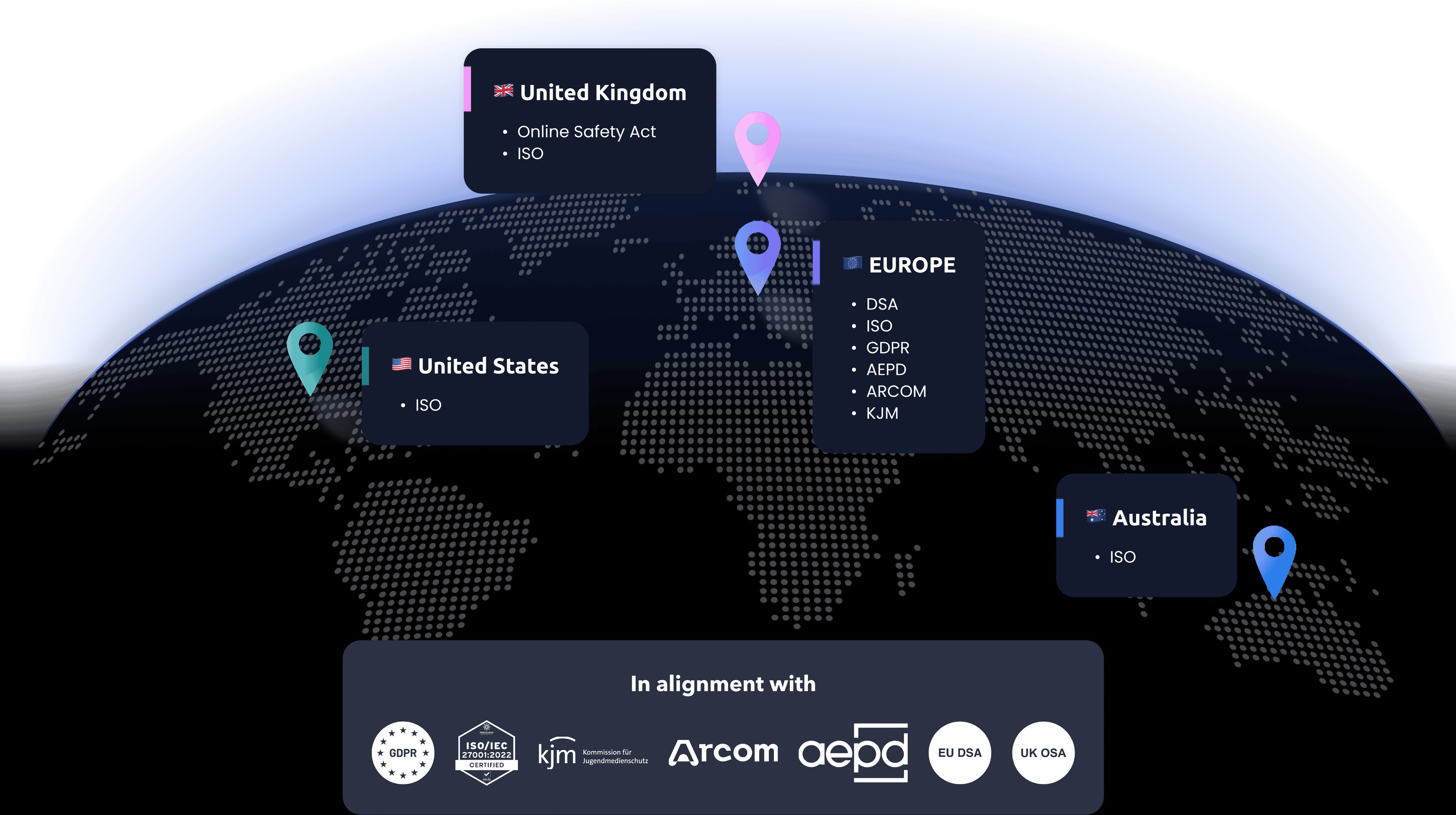
Amie is compliant and certified to the
highest industry standards
Amie is compliant and certified to the
highest industry standards
Meet age verification and privacy requirements across regions, keeping both
your reputation and underage users safe.

Why sites choose Amie
Why sites choose Amie

Fits your markets
Different countries, different age limits, different requirements. Amie adjusts thresholds, methods, and language automatically.

No data liability for you
Visitors do not share any personal information with your platform. Your site receives only the check result (granted or denied), ensuring compliance while eliminating data handling and storage risks.

Easy to integrate
Add Amie with a simple OIDC configuration. Clear documentation guides you from setup to launch.

Intelligence support
You get direct support when you need it, plus real-time trust and compliance signals that help keep checks accurate and compliant.
News
News
Age verification with ID Wallets: confirm your users are age-appropriate and nothing else
May 13, 2024
Age verification online often boils down to a basic question: "Are you over 18?" asked via a pop-up on the website. However, this method has a significant flaw—it relies entirely on trust. Underage users can easily lie, making it an unreliable method for ensuring compliance and protecting minors.
Effective age verification systems must prevent minors from circumventing security measures and accessing the platform, all while providing a simple and private user experience for adults.
In this context, let’s see why ID wallets are emerging indisputably as the best method for age verification, offering strong compliance and protection for children, along with exceptional privacy, security, and ease of use.
What is an age verification system?
An age verification system acts like a gatekeeper, ensuring that only individuals of a certain age can access specific services or purchase age-restricted items.
This system is commonly implemented on platforms that offer content, products, or services intended for adults, not only to comply with legal requirements but also to protect minors.
They involve users providing proof of their age through various means to confirm their eligibility to access the platform's content or services.
When should you use an age verification system for your business?
Your organization should use age verification in the following situations:
1. Legally mandated:
If the law requires a minimum age for buying or using your products/services as they could harm a child's development. This includes alcohol, tobacco, gaming, adult content streaming, and dating websites.
When verifying age is needed to make contracts legally valid. For example, if the minimum age for contract validity is generally 18, parental permission might be required in digital services when minors accept a contract (i.e. an in-app purchase) for the contract to be legally valid.
2. Duty of care to protect children:
When there's a responsibility to safeguard children from accessing content that, while not highly risky, could still be harmful.
3. Contractual obligation:
When there's a contractual stipulation (i.e. in your Terms & Conditions) to provide your products/services to individuals within a specific age range.
For regulated sectors like banking, age verification often intersects with Know Your Customer (KYC) procedures. In these cases, verifying an individual's age is just one part of a broader identity verification process.
On top of this, platforms that operate in the EU or if there is a “substantial connection” to the EU must comply with the Digital Services Act (DSA), which states that online platforms accessible to minors must implement measures to ensure a high level of privacy, safety, and security for underage users, including age verification.
The DSA rules applied since August 2023 to the first designated Very Large Online Platforms (VLOPs) and Very Large Online Search Engines (VLOSEs), such as Instagram or Google, and since 17 February 2024 to all listed platforms.
Age verification challenges
Online age verification has its complexities primarily due to the need to balance reliability, user privacy, and usability.
Age verification systems need to be accurate and reliable to prevent minors from accessing age-restricted products or services. But with children getting better at finding ways to get past age restrictions, robust systems for detecting fraudulent attempts are essential to preventing unauthorized access and adhering to regulatory standards.
In the UK, the Advertising Standards Authority uncovered that 83% of the 11 to 15 year olds registered on a social media site with a false age.
However, a big challenge of age verification is to ensure reliability without infringing the user’s privacy. Users provide personal details during age verification, raising concerns about data breach risks and usage beyond age verification purposes.
A clear example is adult content streaming websites. Age gating is not a reliable method. However, users would think twice before providing their ID documents or scanning their faces to access these websites. It raises the question, “Why do they need my name to know I’m an adult?“.
It is time to end the continuous and massive capture of users' personal data, minors or not. Effective age verification systems should prevent minors from being located through the internet, guarantee the anonymity of adult users, and minimize the data processed or disclosed to third parties.
Additionally, another challenge is user experience. Age verification processes should be intuitive, simple, and seamlessly integrated into the user journey to minimize friction and maximize completion rates. Lengthy or complicated verification procedures, such as scanning multiple times an ID or performing facial analysis, can lead to abandoned transactions or frustrated customers.
With these challenges in mind, what methods do organizations have available to provide a safer digital environment for children?
Common age verification methods online
Many age verification methods exist today, and while each has its pros and cons, none offers a solution to all three challenges (privacy, reliability, and user experience). These are the most common methods:
- Self-declaration or age gating: It is the most common of all methods and involves users honestly telling their age before proceeding. It could be as simple as clicking "yes" to a "Are you over 18 years of age?" prompt, adding a birthdate, or selecting an age from a drop-down menu.
While easy to implement, it mainly serves as legal protection for businesses rather than effective minor protection since users can easily lie. Therefore, age gating is not a compliant method for reliable age verification.

- Credit card: Users input their credit card details to prove their age by assuming possession indicates legal age. However, apart from the privacy and security concerns that are present in providing such financial information, children can bypass this verification by obtaining an adult’s credit card, as it is not possible to confirm that the person using the card is the legitimate owner.
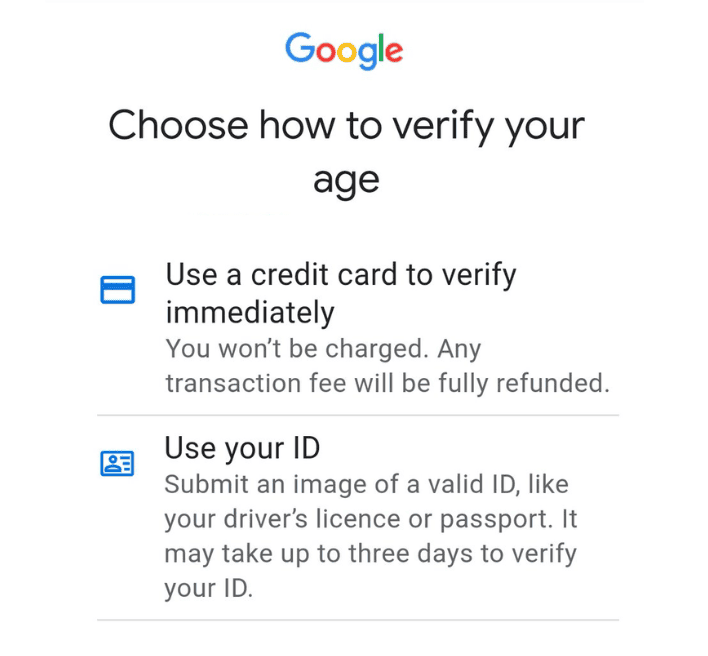
A quick search on this topic reveals multiple questions from people on Reddit and other forums wondering why they need to share this sensitive information for age verification or even how to obtain a fake credit card, not to provide their real information.
- ID verification: Users upload a scanned copy of their government-issued identification. This is a reliable but data-sensitive method as it raises questions regarding the need for extensive personal information beyond age verification.
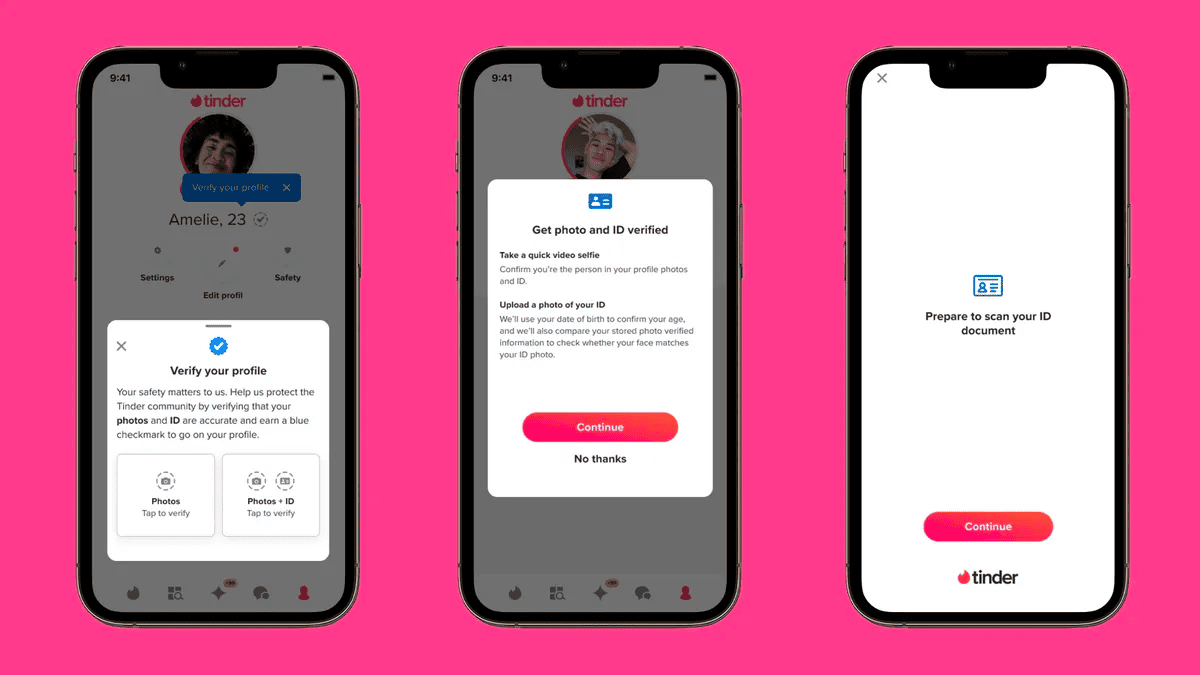
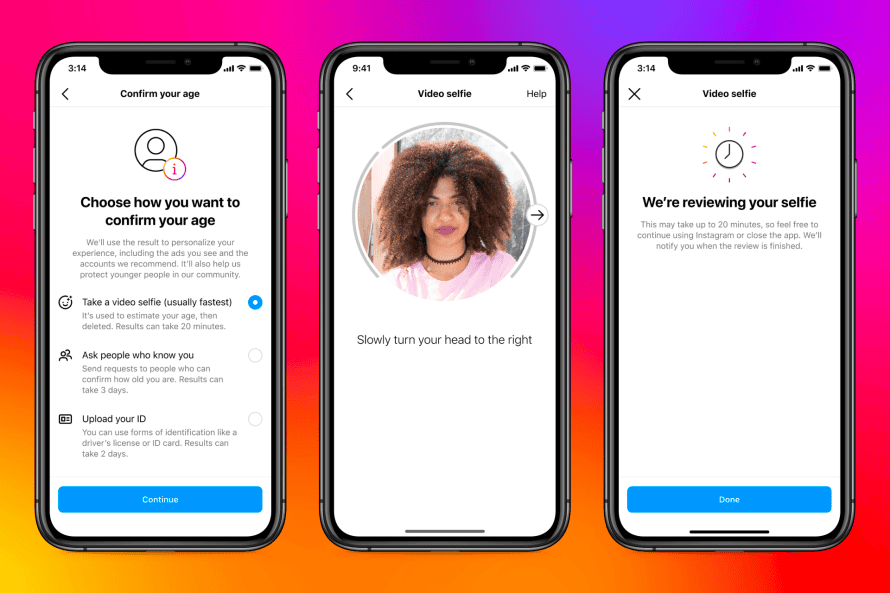
- Facial age estimation: Users take a selfie or complete a liveness check, and artificial intelligence (AI) is used to analyze their facial features and estimate their age. However, this method can be tedious and prone to errors, and it raises privacy issues because they may use special categories of personal data.
Moreover, using these applications to estimate a child's age can also lead to excessive data processing and profiling.
ID Wallets for age verification: Why are they the best method?
A digital ID wallet, such as the Gataca Wallet, is a phone or website app allowing users to identify and prove facts about themselves via verifiable credentials, which are digital documents containing information about a person.
Imagine it as the digital wallets you use for payments on your phone, such as Apple Pay or Google Pay, but going one step further, storing credentials like national IDs, passports, diplomas, health records, and more.
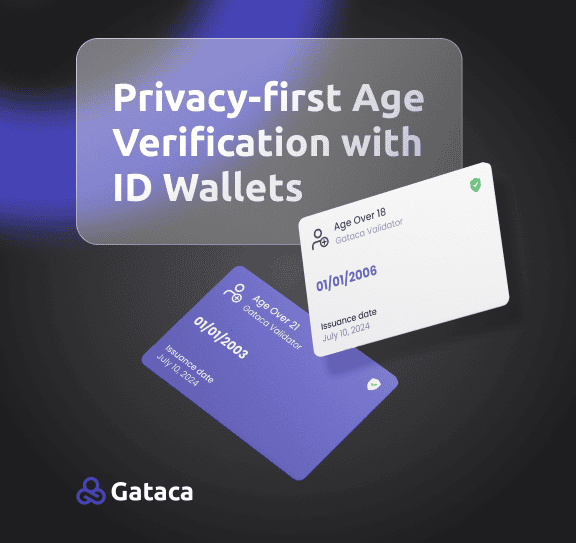
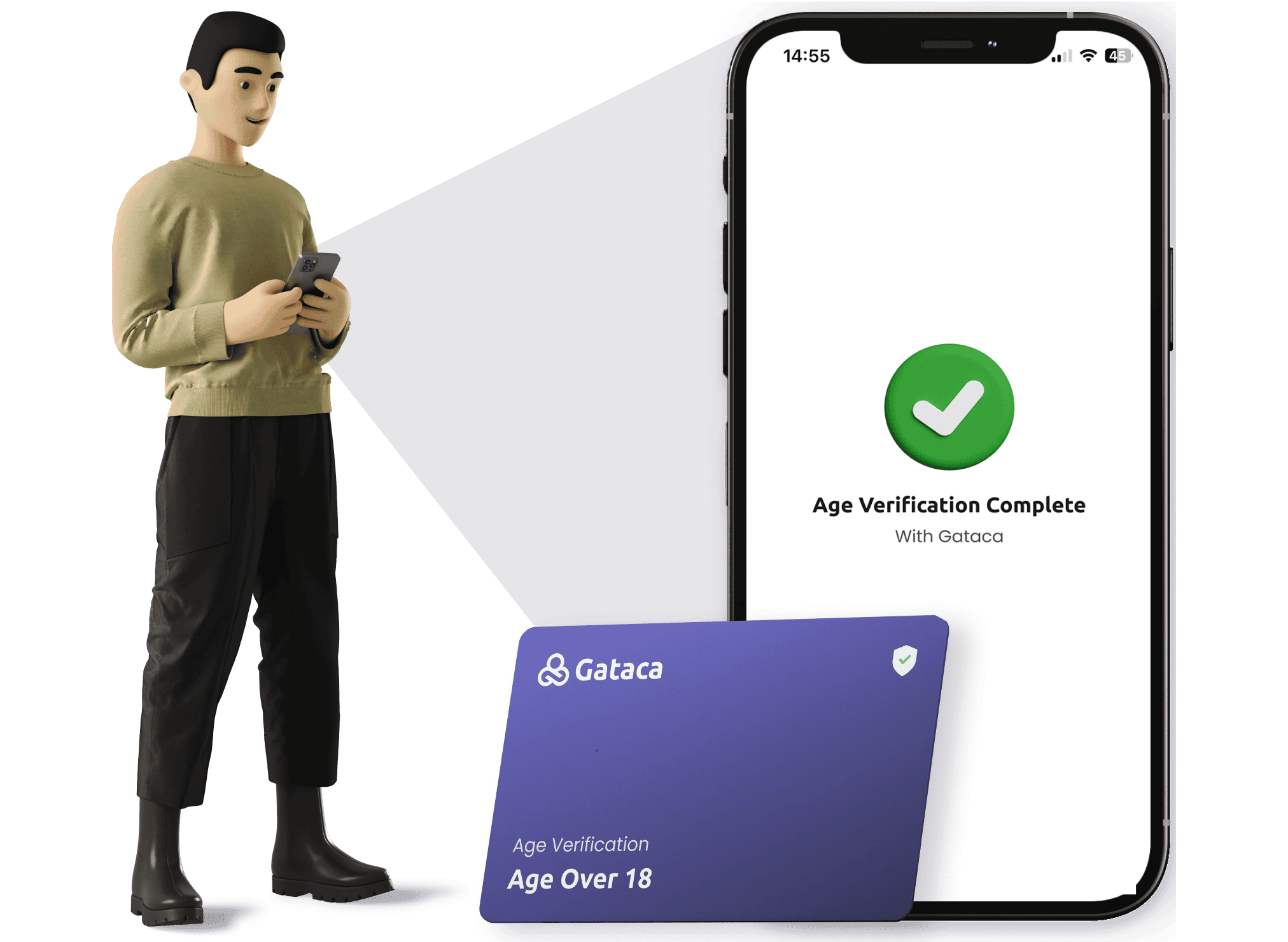
But why is this relevant for age verification? ID Wallets allow users to prove their age without disclosing other personal data. This can be done through selective disclosure, choosing only to share their birth date, or by providing an “Age Over 18“ credential, which would not provide any other unnecessary information than what age verification systems require.
So, let’s analyze why ID Wallets outshine traditional methods:
- Security: ID wallets use in-device biometrics, strong encryption, and self-storage (information is stored on the user's device), ensuring the highest level of security for sensitive personal information and minimizing the risk of data breaches.
- Safety: Only authorized users can access your services as you can automatically verify the authenticity of the data, protecting underage users from accessing inadequate content, products, or services.
- Privacy and Control: Using an ID wallet, users gain greater control over their personal information by choosing what data to share and with whom, with the option to revoke consent anytime. Moreover, verifiable credentials allow granular consent to share only what’s needed and nothing else.
- User Experience: With ID wallets, individuals have immediate access to their verifiable credentials from their mobile devices, and they can share them with just one click.
For EU organizations, it is important to mention that ID Wallets are aligned with the recently approved eIDAS 2.0 regulation. This directive stipulates that member states and impacted organizations will have to accept ID Wallets as an authentication method.
Gataca Vouch: Privacy-first Age Verification
Gataca Vouch is an Identity Provider (IdP) solution designed to make age verification easy and secure by interacting with ID Wallets.
With Gataca Vouch, users can prove they are of legal age with just a tap on their phone, without revealing any personal information. This ensures complete anonymity for adults and minimizes any impact on platform traffic.
How it works?
Users scan a QR code with their ID Wallet before accessing restricted content, share a credential confirming they are above the required age with a single click, and gain instant access—no personal information is shared, not even their exact age or birthdate.
The credential shared is an "Age Over 18" (or the required age) verifiable credential obtained within the Gataca Wallet.
What Sets Gataca Vouch Apart?
Unlike federated identity systems like "Sign in with Google" or Facebook, Gataca Vouch doesn't store user information. Instead, users manage and store their data in their ID Wallets, ensuring privacy and control.
Gataca Vouch is also adaptable for various identity verification needs, making it a versatile solution and opening new business opportunities for organizations beyond age verification as demand for ID Wallets and verifiable credentials continues to grow.

Germany Cracks Down on Age Verification Starting December 2025
November 25, 2025
Starting December 1, 2025, Germany will step up enforcement of age verification rules for adult sites and other 18+ platforms. State media regulators will be able to go beyond blocking websites, stopping banks and payment providers (PSPs) from processing payments for sites that don’t comply.
Germany Age Verification Requirements
Germany’s Interstate Treaty on the Protection of Minors in the Media (JMStV) requires that content harmful to minors—including pornography, online casinos, betting, alcohol and tobacco sales, or violent and sexual user-generated content—must be restricted to adults.
This obligation applies to all “telemedia” services, including websites, streaming platforms, and apps.
In practice, this means that online services with 18+ content must use an approved age verification system (AVS) before users can access their content. Only AVS approved by the Commission for the Protection of Minors in the Media (KJM), such as Gataca age verification solution, are legally valid.
The KJM requires all approved age verification systems to:
- Confirm identity: Make sure the person presenting proof of age is actually the individual associated with it.
- Minimize data: Collect only the information needed for age verification.
- Ensure security: Use encrypted, secure transmission for all data.
- Protect privacy: Fully comply with GDPR and German data protection laws.
What Changes on December 1, 2025?
From this date according to the Sixth Interstate Amendment to Germany’s media treaties, regulators can target payment flows, not just the website itself.
This means, banks and payment providers can be forced to block payments to adult sites that ignore age verification requirements or lack adequate AVS. Plus, non-German websites serving German users are in scope so mirror domains or routing tricks won’t protect against enforcement.
What Methods Are Allowed?
The KJM doesn’t mandate a single system but sets strict standards. Simple “age gates” or self-declared checks are not enough. The KJM’s AVS grid lists positively assessed systems, which are continuously updated.
For a long time, the classic solutions were POSTIDENT, ID upload or credit card verification, but these provide a bad user experience for users and are sensitive in terms of data protection.
There are now more innovative approaches that have been recognized by the KJM and which Gataca provides:
- Facial Age Estimation: A quick selfie confirms age with AI and liveness detection—no ID upload or personal data storage.
- Digital ID Wallets: Users verify once, then can instantly access sites with a click using a secure digital wallet.

How to ensure compliance with Gataca
Meeting Germany age verification requirements doesn’t have to be complicated. Gataca makes it easy with a fully compliant solution designed with the fastest and simplest user experience to drive top conversion rates when users reach the age verification step.
We offer KJM certified methods, so you can choose what works best for your business:
- Facial Age Estimation – Users take a quick selfie and our AI estimates their age and confirms they’re real through liveness detection. No ID uploads, no stored images, no personal data.
- Gataca App (ID Wallet) – Users complete a one-time ID check to receive a verified proof of age in their digital wallet. They can then share it with just one click to access instantly your site or anywhere digital ID wallets are accepted.
Both options use passkeys for returning visitors, making verification faster and safer.
This is aligned with the EU Digital Services Act (DSA) and the upcoming EUDI Wallet, which should be available by the end of 2026, ensuring your platform is not only compliant now but future-ready.


Italy’s New Age Verification Requirements for Adult Content
October 27, 2025
In April 2025, the Italian Communications Authority (AGCOM) approved Resolution No. 96/25/CONS as part of the “Caivano Decree” in a major move to strengthen the protection of minors online.
A few weeks later, AGCOM introduced new technical and procedural rules that require websites and video-sharing platforms hosting adult content accessible from Italy to verify users’ ages before granting access.
These measures set out how platforms must implement reliable age verification systems to stop minors from viewing adult or otherwise restricted content—such as pornography, gambling, or the sale of alcohol and tobacco. All affected platforms must comply by November 2025.
Practical implications for adult platforms
At its core, the age verification system has two main steps:
- Identification: Users must first prove their age through certified digital identity systems (such as SPID, CIE, or digital identity wallets) or by using privacy-preserving facial age estimation without storing or linking personal data.
- Authentication: Each time a user accesses restricted content, they must authenticate again to confirm they are the same verified adult.
Since this process involves the processing of personal data, the law requires certified third-party intermediaries to protect user privacy and comply with the GDPR’s data minimization principle. Independent providers, like Gataca, handle age checks without sharing personal data with the adult platform.
In practice, this means the verifier (age verification providers) doesn’t know which site or service the user is trying to access and the platform (the adult site) never receives any identifying information about the user.
This dual separation—known as “double anonymity”—prevents any single party from being able to link identity data with browsing or content access habits, ensuring the anonymity of the person accessing the adult site.
Technically, the process works in three steps:
- A user obtains a proof of age from a certified entity (like a digital ID provider).
- That proof is stored or downloaded by the user and shared with the verifier.
- The platform only receives a yes/no confirmation that the user is 18+ and grants or denies access.
In short, adult content platforms will need to integrate age verification mechanisms that protect minors while protecting user privacy, a balance that will require both technical adaptation and close attention to compliance.
What are the consequences of non-compliance?
Platforms that fail to meet the new age verification requirements within the set deadlines risk enforcement action by AGCOM. This may include sanction procedures such as significant administrative fines on operators that ignore its orders or warnings, or even blocking orders for non-compliance.
How to comply with Italy's age verification requirements
AGCOM has taken a technology-neutral approach, meaning platforms are free to choose how they implement age verification as long as the system meets the following legal and technical principles:
- Proportionate: The method used to verify age should strike a fair balance between protecting minors and respecting users’ privacy.
- Data-safe: Any system must comply with the GDPR. Collecting or storing personal data like ID documents or selfies is not allowed.
- Secure: Strong cybersecurity measures must protect the system from hacking or misuse. The verification process should be hard to bypass.
- Accurate and effective: The system must reliably confirm users’ ages every time they log in or access adult content. A verification session ends when the user closes the browser, logs out, or is inactive for more than 45 minutes.
- Easy to use: The process should be simple, fast, and inclusive, including for people with disabilities.
- Transparent: Users must be clearly informed about how the age verification works and how their data is handled.
- Non-discriminatory: The system should work equally for everyone, without bias.
- Responsive: Platforms must offer a clear and quick way for users to file complaints about incorrect age checks.
At Gataca, we offer two age assurance methods and both are fully compliant with these requirements.
How Gataca can help
Meeting Italy’s new age verification requirements doesn’t have to be complicated. Gataca makes it easy with a fully compliant solution designed with the fastest and simplest user experience to drive top conversion rates when users reach the age verification step.
We offer two AGCOM-compliant methods, so you can choose what works best for your business:
- Facial Age Estimation – Users take a quick selfie and our AI estimates their age and confirms they’re real through liveness detection. No ID uploads, no stored images, no personal data.
- Gataca App (ID Wallet) – Users complete a one-time ID check to receive a verified proof of age in their digital wallet. They can then share it with just one click to access instantly your site or anywhere digital ID wallets are accepted.
AGCOM explicitly recognizes digital identity wallets as a valid and compliant way to perform age verification and even encourages them in anticipation to the upcoming EU Digital Identity Wallet. Facial age estimation is also accepted, provided it runs locally, stores no biometric data, and complies with AGCOM’s privacy, proportionality, and accuracy principles.
Both methods use passkeys for returning visitors, providing a more convenient and secure experience.
The message for platforms is clear: with the enforcement deadline fast approaching, now is the time to act and stay compliant the easy way with Gataca.
Contact us
Contact us